


- on foot : 1h30 - Difficulty Easy
- Distance : 2km
- Public : Tous publics
Step 1 :
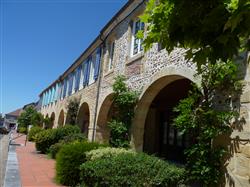
Place de la République The triangular-shaped square in the 14th-century English bastide was designed for the market. Arzacq's market was one of the largest in Guyenne and remained so until the Second World War. In the middle stood the market hall, which was demolished at the end of the 19th century. All around, covered galleries with pillars and arcades sheltered the merchants.Step 2 :
The Errecart House At No. 8. Dating from the early 19th century: long façade, bull's-eye windows, triangular pediment, left pavilion with high hipped roof. Garden and park at the rear. This is the former home of the Bailac and then Boulin families of doctors (who were also mayors of Arzacq).Step 3 :
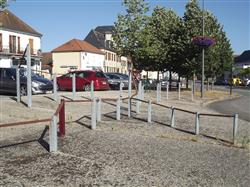
The division Between the market hall and the Errecart house was the Place du Sel et de la Résine (Salt and Resin Square), named after two highly consumed products from the neighbouring Landes region. On feast days, this square became the venue for the Course Landaise, closed off by makeshift barriers. Beyond that, to the west, was the Place du Grain, for trading wheat, barley, millet, beans, broad beans and chestnuts (quays).Step 4 :
The Café des Arcades At No. 9. Nineteenth-century building, now restored. A noble house that once belonged to the Guichané-Gondrin family, then to the Peich family in 1789. On the left, in the courtyard, are the former stables.Step 5 :
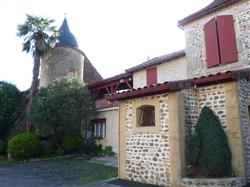
The Tower of Peich On the right, in the café's inner courtyard. A remnant of the old ‘castle’, Henri IV is said to have stayed here during his visits to Hagetmau, where he would meet the beautiful Corisande d'Andoins. Louis XIII also stayed here during his visit to Arzacq on 14 October 1620. He was on his way to Pau to restore the rights of Catholics. In fact, he annexed Béarn to France. Note the originality of the hipped roof (restored in 1991).Step 6 :
Saint Peter's Church Built in 1860, it houses an old listed wooden Christ, a stained glass window of Saint James of Compostela, and a polychrome lime wood statue of the Virgin Mary dating from the late 15th or early 16th century. This ‘Virgin and Child’ is said to be a royal gift from Louis XIII and Anne of Austria on the occasion of the long-awaited and much-desired birth in 1638 of the heir to the French throne: Louis Dieu Donné, the future Louis XIV. The king had placed the kingdom under the protection of the Virgin Mary (the Queen's Vow).Step 7 :
The Town Hall At No. 13. The town hall dates from the 19th century. Continuing under the arcades, old studded wooden doors, old brick paving (Nos. 15 and 15 bis).Step 8 :
The lower town The oldest part of Arzacq (Castelnau). The old mud-brick houses have given way to more modern buildings around two small squares: Place Craco and, further away, Place Picard, where the pillory (place of justice) once stood. On the right is the feudal motte (inaccessible).Step 9 :
The houses on Place de la République At the crossroads and on your right (at No. 2 Route d'Orthez) is a former bourgeois house belonging to notaries, whose dormer windows have unfortunately been removed. Cross over and walk under the arcades. The Gouze (hairdressing salon) and Salles (No. 34, newsagent's) houses are typical with their double roofs and dormer windows. The Momas house (No. 35) has been restored in its original style, with pebble walls and tiles.Step 10 :
Passage to the lake Between the optician's and the hairdresser's, head down towards the lake on Chemin de Larrouze, then turn right onto Chemin de Saint-Jacques. Once you reach the lake, turn right and follow the dyke to turn right towards the wash house.Step 11 :
The wash house Just after the lake dyke, below. A beautiful wash house with a horseshoe-shaped roof dating from the 19th century. A second identical wash house can be found at the other end of the lake in the commune of Vignes. Retrace your steps and take the same path again. At the fork, turn right.Step 12 :
At Donney's On your left, now a butcher's shop at No. 49, is a 16th-century building with mullioned windows (crossbars). Note the sculptures: a flute and tambourine player, a vine branch topped by a crowned figure, a scribe and a grotesque (half-man, half-animal).Step 13 :
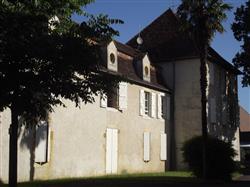
The Mimbielle House This house (No. 50) is a former 18th-century manor house. It was bequeathed to the municipality, which recently restored it in keeping with the original architecture (except for the west façade: gallery and dormer window). Note the central section of the east façade with its double roof covered in ‘picon’ tiles (flat tiles made in the region), its masonry dormer windows and its pavilions at each end. This house is the former residence of the judges of the Viscounty of Louvigny, the Ducasse family, judges from father to son, ennobled in the 17th century under Louis XIV. The grounds of the manor house extended to the rear, where the retirement home now stands. The old well from that period can still be seen there.Step 14 :
Maison de Maîtres Maison de Maîtres (to the right of the Mimbielle house, at No. 49) with 19th-century arcades, a projecting upper floor and a sundial at the top of the pavilion.Step 15 :
Place du Marcadieu This square is a former fairground. It was here that livestock markets were held. On one side were oxen, cows and calves; on the other, horses, mules and donkeys. Pigs and piglets had their own place elsewhere (near the bakery).Step 16 :
The sculpture of Saint-Jacques Opposite the music shop, an original creation by architect Canet, evoking the Way of St Jacques and its difficulties.Step 17 :
The presbytery Built in the early 19th century and bequeathed to the municipality in 1854 by Father Dufau-Fortis, it was restored in 1990. The walls are made of rounded pebbles and traditional mortar. The door and window frames are made of local stone and the dovecote is now a studio. The tower with its spiral stone staircase leads to all floors. It comes from a castle, probably in the Landes region. You can enter the courtyard to see the tower.
 The arcades (Built heritage) (Heritage)
Covered galleries with pillars and arches.
- Peich Tower (Built heritage) (Heritage)
A remnant of the old castle, Henri IV is said to have stayed here during his visits to Hagetmau, where he would meet the beautiful Corisande d'Andoins. Note the originality of the hipped roof.
- Sculpture (Small heritage site) (Rural heritage)
An original creation by architect Canet, evoking the Way of St James and its difficulties.
- Manor house (built heritage) (Heritage)
Dating from the 18th century, this former manor house has been restored by the local council: double roofs with picon tiles and masonry dormers, pavilions at each end. Former residence of the judges of the Viscounty of Louvigny.

Nearby routes

Arzacq-Arraziguet : Saint-Jacques de Compostelle
The bastide town of Arzacq, on the route to Le Puy en…
ARZACQ-ARRAZIGUET
Arzacq-Arraziguet : tour du lac
The 20-hectare Lac d'Arzacq is used for agricultural purposes (irrigation). The north/north-western…
ARZACQ-ARRAZIGUET
Arzacq : Saint-Jacques de Compostelle à VTT
The bastide town of Arzacq, on the route to Le Puy en…
ARZACQ-ARRAZIGUETNearby accommodation

Maison Pantalou
Bed and breakfast in a small corner of paradise on the roads…
ARZACQ-ARRAZIGUET
La Maison d'Antan
La Maison d?Antan is located in the center of the bastide village…
ARZACQ-ARRAZIGUET
L'Etape béarnaise
Nestled in the heart of the pretty bastide town of Arzacq-Arraziguet, close…
ARZACQ-ARRAZIGUETAgenda
 06May
06May
Creative workshops for children to awaken their artistic spirit. 10am/11.30pm: 3/6 years. 2.30pm/16pm: 7/12 yrs. Registration by Tuesday, 12pm.
ARZACQ-ARRAZIGUETUseful links


