


- on foot : 1h15 - Difficulty Easy
- Distance : 2km
- Public : Tous publics
Step 1 :
Morlanne Castle The castle was built in 1373 by Gaston Fébus for his half-brother Arnaud Guilhem. He chose Morlanne as a defensive stronghold during the Hundred Years' War. Arnaud Guilhem then married Jeanne de Morlanne and became Lord of the village. The castle survived the centuries and its many owners turned it into a pleasure palace. The RITTER couple restored it in the 1970s and it was listed as a Historic Monument in 1975. The wooded park is perfect for strolling and enjoying the magnificent view of the Pyrenees. Self-guided and guided tours. Tel: 05 59 81 60 27 — www.chateaudemorlanne.frStep 2 :
Convent and fountains of the Sisters Take the Château lane. After 150 metres, you will arrive at the site of the village gate. The house on your right (no. 31) was home to a convent, that of two Sisters of the Order of the Daughters of the Cross. They had a religious role, but not only that. They also ran sewing workshops and visited the sick and the poor. Turn right. Below, take the path to the Sisters' fountain: apart from the castle, only three houses on the street had wells. The village's location on a ridge made it difficult to supply drinking water for both humans and animals. The fountain (like the one in Benteyac, behind the church) is fed by an aquifer and has three basins, each with its own function: drawing drinking water, washing clothes and watering animals. Go back up towards the Carrère and turn right.Step 3 :
La Carrère du Château Rectilinear and built to connect the castle and the church, this street is lined with picturesque houses typical of the Béarn region. Built with pebbles from the river embedded in mortar, their steeply sloping roofs (usually four slopes) are covered with flat tiles called ‘picon’. The presence of clay deposits made it possible to create brick frames for the openings and corner chains. These flat bricks were also used for the double cornice that connected the roof to the top of the wall. Laid in corbelling and filled with mortar, the bricks thus produced a decorative cornice. In the 1940s and 1950s, all trades could be found on the street: duck cooperative (No. 26), seamstress (No. 33), convent (No. 31), clog maker (No. 29), farrier (No. 23), blacksmith (No. 21), carpenter (No. 19), potter (No. 18), tax collector (No. 14), barber, hairdresser and tooth puller (No. 13), café-bistro (No. 10, now Cap e Tot or No. 7), grocer (No. 6), and post office (No. 2).Step 4 :
The Town Hall At the top of the street on the right at No. 1, the Town Hall, dating from 1883, is a typical 19th-century town hall building with large arched doors opening onto a hall with a fairly high ceiling and an administrative office upstairs.Step 5 :
Saint Laurent Church This building dates back to the 10th century, with its oldest parts dating from the 13th century. Gaston Fébus decided to use it as a defence against the English and had it fortified in the 14th century (the arrow slits still bear witness to this). The original bell tower is square (at the rear) and is undoubtedly the oldest part of the building. The other two towers, one round and the other octagonal, were built to serve as watchtowers. In 1911, the battlements, arrow slits and parapet walk disappeared during restoration work. The façade was restored in 2006, and the interior features rich furnishings dating from the 17th and 18th centuries, including the lectern (17th century), the pulpit and the confessional (18th century). Late 15th-century Gothic art predominates in the church's architecture, with its ribbed vaults and lancet windows. Listed as a historic monument in 1911, discover three side chapels facing the large south door, which were successively added from east to west between the end of the 15th and the beginning of the 16th century. The second chapel was reserved for the Belluix family, wealthy owners of the large building located a few steps from the church. On the floor, amid the red brick tiles, the nave has nine tombs covered with gravestones. One of them holds the remains of David de Frèche, Lord and Baron of Morlanne, who died in 1775, and another holds those of a member of the Belluix family.Step 6 :
The Belluix House Opposite the church, enter the courtyard (at No. 3). This imposing building dates from the late 15th and early 16th centuries. It has had three successive owners, hence three different names: - The Belluix House, because it was the Belluix family who built it in the late 15th century. Jurats from father to son, the family grew wealthy and wanted to show off their financial power. They bought part of the fiefdoms of the secular abbey of Morlanne and undertook construction projects such as the family funeral chapel in the church and the Belluix house. - In the 18th century, another name appeared: Domecq. In 1790, Pierre Martin de Domecq was mayor of the village. His son emigrated to Puerto Rico to seek his fortune, and one of his descendants sold the property to the Pintat family. - Pintat then became an important name in Morlanne and the building was converted into a flour mill. The grain was stored on the upper floors, which were accessed via the tower. The bakery was located in what is now the school canteen. The Pintat family's business prospered until 1984, when they sold the building to the municipality. Restored in 2010, this building now houses a media library on the second floor, among other things. A rural market organised by the Morlanne sur la Place association is held there every Thursday from 4pm to 7pm, with baking in the wood-fired oven on the last Thursday of every month.Step 7 :
Former workshop for manufacturing 9-pin skittles The current Maison de l'Enfance (Children's Centre) once housed the Navarron workshop, a former factory producing 9-pin skittles, a game that is emblematic of Béarn, Bigorre and the southern Landes region. Marcelin Navarron (1867–1947) began manufacturing them in 1892. Not much is known about the origins of this game, but Henri IV is said to have played it in the inns of the Béarn countryside. Carved from beech wood, the skittles from the Navarron workshop remain historic in the evolution of the game, and it was Marcelin who undertook to completely renovate it by imposing a high-quality technique. Until 1954, 9-pin bowling enjoyed its heyday in Morlanne with Pierre Navarron (son of Marcelin, who sent his last set of pins to Buenos Aires), but also, more recently, with the very last Morlanne manufacturer, Alain Ducassou.Step 8 :
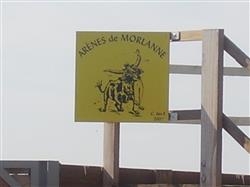
The bullring To the left of the church, take Rue des Arènes, which turns right, and continue for 200 metres. In 1978, thanks to a network of strong friendships, the wooden bullring in Vielle-Tursan (40), which was being rebuilt, was purchased and moved to Morlanne. The Morlanne bullring is a bit like the Cinderella of Béarn bullfighting, alongside Orthez, Arzacq-Arraziguet and Garlin. But it was thrust into the spotlight when around twenty Morlannais residents renovated it. Previously, an account book attests to its existence as early as the 19th century. The enclosure consisted of ox carts placed end to end and set up on the church square...Step 9 :
The Nougadère path Retrace your steps and, after 50 metres, turn right at the calvary. The Nougadère (named after the walnut trees that used to be very common here) is part of the ‘Le Château’ hiking trail. Pass under the departmental road that leads into the village from the west, before returning to your starting point in front of the Château.
 The arenas (Small heritage sites) (Rural heritage)
In 1978, thanks to a network of strong friendships, the wooden bullring in Vielle Tursan in the Landes region was purchased and moved to Morlanne. It was given a major facelift and refurbished by around twenty Morlanne residents. It is known as the Cinderella of the Landes region's bullfighting tradition.
- The lectern (Small heritage site) (Rural heritage)
Inside the church, there is 17th-century listed furniture, including the lectern, the pulpit and the confessionnal.


Nearby routes

Morlanne : les Palombières à VTT
The tour takes you through the heart of the palombières on a…
MORLANNE
Morlanne : les Palombières
The tour takes you through the heart of the palombières on a…
MORLANNE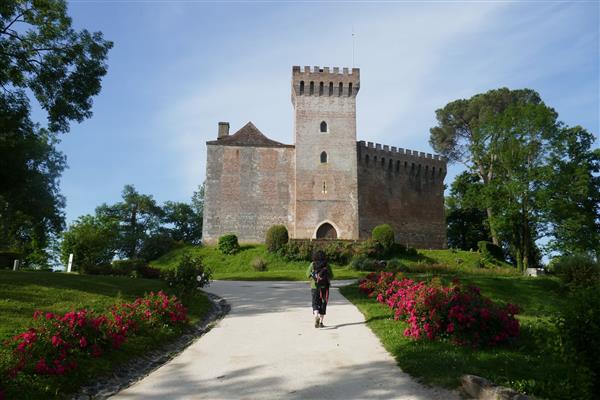
Morlanne : Le Château
This short, easy loop takes you through the medieval village of Morlanne.…
MORLANNENearby accommodation

Au Castet Bieilh
Just a stone's throw from the fortress of Gaston Fébus, in the…
MORLANNE
Cabane aux arbres tordus
Nestled in Béarn, on the edge of the forest, in the pretty…
MORLANNE
Chambres " Ailleurs "
In an old property of Béarn, not far from the fortress of…
MORLANNEAgenda
Useful links


