


- on foot : 1h15 - Difficulty Very easy
- Distance : 3km
- Vertical rise : 10m
- Public : Famille - Tous publics
Step 1 :
The route starts at Sauvagnon Waterfall (Chemin du Luy). Take the path behind the bus shelter. Follow the fitness trail through the woods along the Luy. The mountain bike trail branches off to your left. Do not take this trail. Continue for 100 metres along the Luy, then turn left after crossing the road.Step 2 :
You will reach the Cuyala path. It gradually leaves the banks of the Luy. Continue straight ahead. At the first crossroads, take the track opposite. After about 600 metres, cross the local road (the Morlane path) and continue straight ahead on the track.Step 3 :
It branches off to the left. After 700 metres, you reach a crossroads.Step 4 :
Take the grassy track on the left, which heads northwards. It zigzags a few times. After about 1,300 metres, you will rejoin the local road, which you follow to the left for 50 metres.Step 5 :
Leave it and take the track on the right heading due north. The track turns into a road. Continue straight ahead.Step 6 :
We rejoin the route along the Luy, which we follow to the right to return to the Sauvagnon waterfall and our starting point.
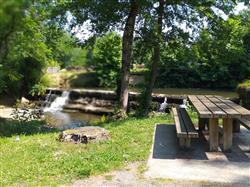
 Sauvagnon Waterfall (Nature site)
The Sauvagnon waterfall, as you can see, is not natural. It was created to enable a mill to operate. Between the 19th and early 20th centuries, there were many mills in the region. In Sauvagnon, there were three mills: two on the Luy de Béarn (the Sauvagnon mill, which operated until 1960, and the Buret mill) and one on the Gées river (the Biegue mill). All equipped with three pairs of millstones and flying wheels, they were used to produce flour. The Sauvagnon mill was the most powerful, with 7 horsepower.
Nearby routes

Sauvagnon : dans la plaine du pont long à VTT
An easy nature bike tour, it allows you to explore an area…
SAUVAGNON
Sauvagnon : dans la plaine du Pont Long
Here's an easy hike that will guide you through the colorful and…
SAUVAGNON
De Sauvagnon au lac du Balaing
This is not a long ride, but it does require a certain…
SAUVAGNONNearby accommodation

Hôtel Nemo
Hotel Némo is located opposite Pau Pyrénées airport, 15 minutes from the…
SAUVAGNONAgenda
Useful links


